How to Stop Your Dog Pulling on the Leash (Loose-Leash Walking)
Pulling isn't stubbornness — it's a habit you can retrain. Here's the loose-leash method that works without yanking.
To stop leash pulling, reward the slack: the moment the leash goes loose, mark and treat while you step forward; the instant it goes tight, stop and plant your feet. Don't yank — make pulling useless and slack rewarding. Practise indoors first, then on quiet walks, and stay consistent. Most dogs walk calmly within two to three weeks.
Leash pulling is the single most common dog-walk frustration, and it's almost never a stubborn-dog problem. It's a straightforward habit: the dog has learned that pulling moves them forward, so the fastest route from the sofa to the park is to lean into the leash. Retrain it by making the exact opposite — a slack leash — the thing that reliably pays off.
Why dogs pull (and why yanking doesn't fix it)
When you pull back on the leash, a dog who is already walking fast simply keeps walking fast — the tug becomes part of the background noise, not a cue. And a clean forward-conditioning loop is powerful: every step the dog takes on a tight leash is a step that was rewarded with movement. The fix is to break that loop, not to out-muscle the dog.
The loose-leash method
- Reward the slack: the moment the leash goes loose, mark it ('yes') and treat while you keep stepping forward.
- Make tension a stop: when the leash goes taut, stop and plant your feet — do not give in to the pull.
- Only move forward on a loose leash: no slack, no distance. It's a simple rule the dog learns fast.
Gear that helps, gear that does not
- A well-fitted harness is more comfortable than a collar for a dog that pulls.
- Use a standard fixed-length lead while training, not a retractable one, which teaches that pulling pays.
- Carry small, soft treats so you can reward the instant the leash goes slack.
- No gadget replaces the habit: the method matters more than the equipment.
Make the walk worth remembering
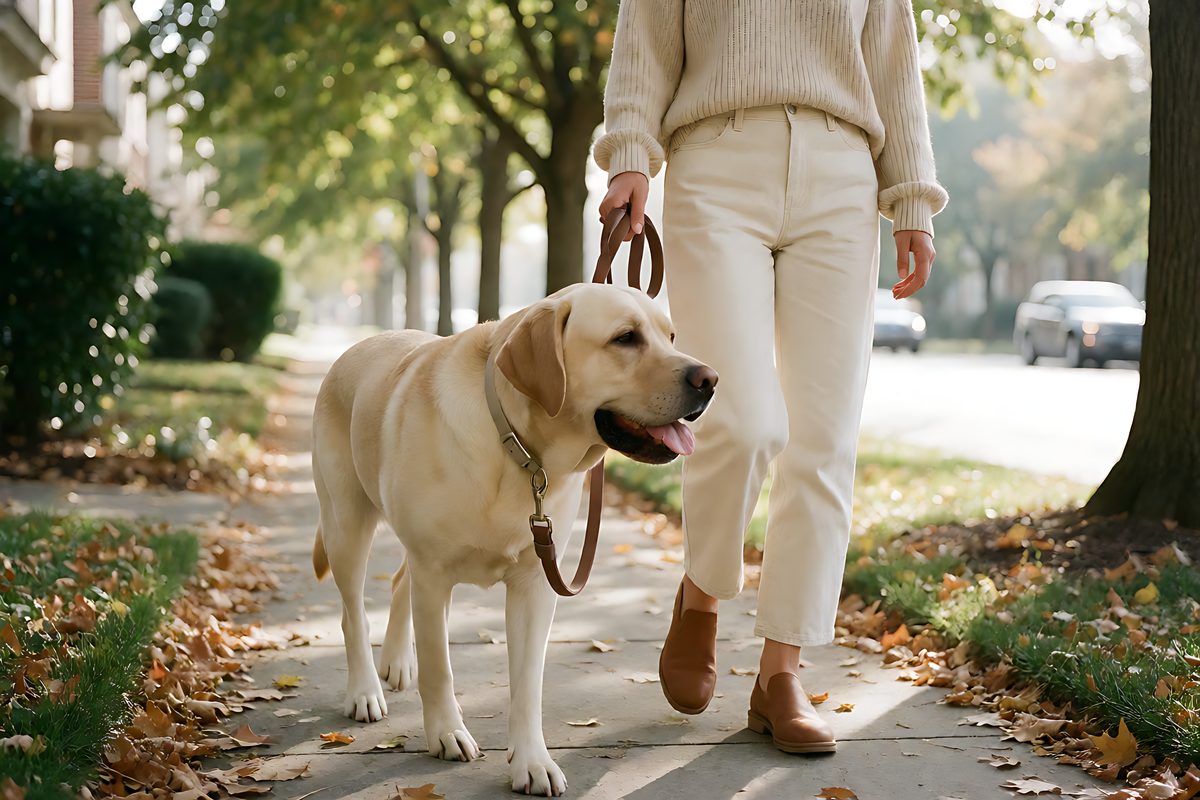
Once the leash is loose, a walk is the best time for a photo: a relaxed dog in open shade, looking back at you. Capture it at eye level, then turn your favourite into a portrait with a free preview at petmona.app/generate.
What not to do
- Don't yank or jerk the leash — it teaches the dog to brace against pressure and damages the trust you need.
- Don't train only in a quiet room and expect it to hold on a busy street — add distractions gradually.
- Don't get frustrated and let them pull on a 'casual' walk; every walk is a training session.
PetMona turns a clear pet photo into wall-ready art — ship an 8×10″ print or unlock HD to gift yourself. Free preview, no subscription.
A five-day loose-leash plan
- Reward slack indoors. In a hallway, walk a few steps and treat the instant the leash is loose. Repeat until loose-leash walking is automatic inside.
- Plant and go. The moment the leash goes tight, stop and stand still. When it's slack again, mark, treat, and move forward. Tension always means 'no progress'.
- Change direction. Without warning, turn and walk the other way. Your dog has to keep an eye on you to keep up, which breaks the lean-and-pull habit.
- Move outside. Take the same rule to a quiet street. Keep treats on you and reward often at first, while distractions are still low.
- Stay consistent. Use the same rule on every walk. Once your dog walks calmly at home and on quiet streets, slowly introduce busier spots.
Frequently asked questions
Is it ever too late to teach an adult dog to stop pulling?
No. Grown dogs learn loose-leash walking very well; it's a habit retrain, not a behavioural problem. Adult dogs often settle into the new rule faster than puppies, because they can hold their focus for a full session. The key is consistency on every single walk.
What should I do when my dog pulls hard toward another dog?
Turn and walk away before you get close, and reward the moment your dog looks at you instead of the distraction. If passing other dogs is a regular struggle, keep more distance and build up slowly. Never let a pulling dog drag you right up to meet another dog.
Does a no-pull harness help?
A front-clip or no-pull harness can help you physically guide the dog while you train, and it removes the strain on their neck. It's a useful tool but not a fix on its own — you still need the loose-leash rule so the dog learns what pays off.
How long until walks are actually calm?
With a couple of short sessions a day, most dogs walk noticeably better within one to two weeks and feel calm on a regular walk within about a month. Big, easily excited breeds can take a little longer; older dogs usually pick it up faster.
What if my dog is too strong for me to physically hold?
Use a front-clip or no-pull harness so the dog can't drag you by the neck, and rely on the stop-and-go rule rather than brute force — you never need to win a tug of war, you just refuse to move forward on a tight leash. A calm, consistent owner plus the right harness beats strength every time.